ここから本文です
TWO:Instantly Larry caught up the receiver.Larry, his hand idly on the useless stick, felt it twitch three times.

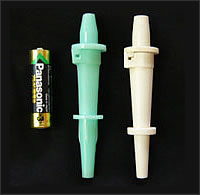
Hydrocyclone (liquid cyclone)01

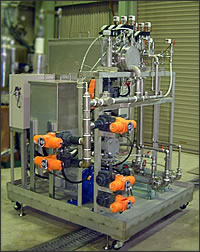
Hydrocyclone (liquid cyclone)02

A hydrocyclone (liquid cyclone) injects treatment solution into stationary equipment to perform separation, classification, and concentration, and is an innovative separator with a very simple structure and no drive unit.

Structure of a hydrocyclone (liquid cyclone)

A suspension containing fine particles of several micrometers or more is supplied to a cylindrical container circumferentially at high speed. And as a result it starts to rotate and a centrifugal force is generated. At this time a gravitational acceleration of several tens of thousands of G is generated in the circumferential direction, and thus leading to fast sedimentation and concentration of the fine particles. The separated concentration can be freely selected by changing the supply rate (supply pressure and flow rate) and the flow ratio of the outlet. Our hydrocyclone (liquid cyclone) was designed and manufactured to classify and concentrate fine particles, and so has a small element.

THREE:The court then adjourned to the 15th of April. The case of the Begums was opened by Mr. Adams, and concluded the next day by Mr. Pelham. Then sixteen days were occupied by the evidence, and at length, on the 3rd of June, Sheridan began to sum up the evidence, and, in a speech which lasted three days, he kept the court in the highest state of excitement. The place was crowded to suffocation during the whole time, and as much as fifty guineas is said to have been paid for a single seat. Greatly as this speech of Sheridan's was admired, it was felt to be too ornate and dramatic: there was not the deep and genuine feeling of Burke in it, and the effect was so evidently studied, that, on concluding, Sheridan fell back into the arms of Burke, as if overcome by his own sensations. The prorogation of Parliament was now at hand, and only two out of the twenty charges had been gone through: neither of them had yet been replied to, and yet other causes of engrossing interest arising, the trial was entirely suspended till the 20th of April of the following year! Then it was taken up languidly and at uncertain intervals, and rapidly became a mere exhibition of rhetoric. Further, Burke's unlawyer-like style and intemperance of language drew upon him the censure of the Lord Chancellor, and even of the House of Commons. A revulsion of public feeling took place, and was seen in the acquittal of Stockdale who was tried for libelling the promoters of the trial. Three years afterwards Burke himself renounced sixteen of his charges, and all popular interest in the trial gradually disappeared.In the midst of this prosperous career the two brothers-in-law, the Ministers, began to differ in their views, and Lord Townshend was soon driven by the overbearing conduct of Walpole to resign. Lady Townshend, the sister of Walpole, and even Queen Caroline, exerted their influence for some time to put an end to these feuds; but Lady Townshend soon died, and the queen, finding the breach inevitable, took the side of Walpole as the more indispensable servant of the Crown. There were serious topics on which Townshend and Walpole differed, both domestic and foreign. Townshend did not approve of the length to which matters were carried against the Emperor, and he was weary of the timid temper of the Duke of Newcastle, and strongly urged his dismissal, and the employment of Lord Chesterfield in his place; but a Pension Bill brought the quarrel to a crisis. The object of the Bill, which was warmly supported by the Opposition, was to prevent any man holding a pension, or who had any office held in trust for him, from sitting in Parliament. The king privately styled it "a villainous Bill, which ought to be torn to pieces in every particular." Both Walpole and Townshend were of the same opinion; but Townshend was for openly opposing it, Walpole for letting it pass the Commons, and be thrown out in the Lords. Townshend, to whom the odium of rejecting it was thus carried in the Lords, protested against this disingenuous conduct on the part of Walpole, and assured him that the trick would soon be fully observed, and bring more unpopularity on him in the end than a manly, open oppositionwhich it did.
  • Equipment costs can be reduced.
  • Operating costs can be reduced.
  • Maintenance costs can be reduced.
  • Any change in raw material and product can be easily addressed.
  • Large amounts can be treated in a small area.
  • Separation and cleaning are easy because of the simple structure.
  • Simplified control
  • This equipment can be operated in synchronization with external devices.
  • Alarm and interlock mechanism.
THREE:
  • Classification and concentration for the manufacture of inorganic powder materials
  • Classification of ceramic materials
  • Removal of fine particles, including iron powder
  • Removal of fine particles from pigments
  • Removal of fine organic particles from solvents
  • Separation of starch and yeast
  • Removal of fine particles from high-temperature strong acid solutions
  • Removal of fine particles from low-temperature solutions